The border
01 · For companies You ship across it. Importers, manufacturers, carriers and 3PLs who need goods to clear, stay in channel, and cost only what they should. Trusted-trader certification and validationDuty recovery, classification and valuationDiversion, pricing arbitrage and custody Services for companies → 02 · For customs administrations You decide who crosses. Authorities and their development partners who need a program their officers can run after we leave. National AEO/OEA program designRisk, selectivity and post-clearance controlOfficer training and corridor pilots Services for administrations →The record · Verified
1,500+
U.S. Customs and Border Protection regulatory auditors trained by SIMS, over fourteen consecutive years.
We trained the auditors. Your program is next.
SIMS designed, delivered and evaluated CBP Supply Chain Security Specialist training from the inception of CTPAT. The same discipline now trains your team.
Technical briefing
Find the break before the auditor does.
Thirty minutes on your own records. No deck. We show you where the file would fail, what it would cost at the dock, and what it takes to make it hold.
01 / For companies
You ship across it.
Importers, exporters, manufacturers, carriers and 3PLs who need goods to clear, stay in channel, and cost only what they should.
◆Trusted-trader certification and validation
◆Customs compliance and duty performance
◆Cargo integrity and channel diversion
02 / For customs administrations
You decide who crosses.
Customs and revenue authorities, and their development partners, who need a program their officers can run after we leave.
◆National AEO/OEA program design
◆Risk engines, selectivity and post-clearance control
◆Corridor pilots and officer capability
Step 2 · your services
{{ pn.title }}
{{ pn.sub }}
{{ pn.note }}
Why now
Navigating the enforcement landscape
Trade enforcement has entered a more demanding era. Tariffs, forced-labor rules and an expanding prosecution posture increasingly converge on the importer of record. Each pressure below routes to the work that answers it.
Tariffs & trade remedies
Shifting tariff schedules, safeguard and antidumping duties, and exemption regimes. SIMS monitors the landscape and structures lawful, defensible mitigation.
Customs compliance & duty →Importer accountability
Heightened enforcement of importer-of-record accuracy, bonding and trusted-trader filing. SIMS readies importers and brokers for the standard.
Trusted-trader programs →Trade-fraud exposure
Expanding civil and criminal liability reaching down the supply chain. SIMS builds the records and internal controls that withstand scrutiny.
Data & analytics →Duty recovery
Where duties were overpaid, SIMS prepares the declarations and entry audits that recover them through the lawful refund and protest channels.
Duty drawback & recovery →Origin integrity & transshipment
Verified country of origin is a frontline test. SIMS binds material, financial and information flows so origin claims hold up under scrutiny.
Tariff classification →Forced labor & traceability
Forced-labor import bans demand traceability several tiers deep. SIMS maps partners and evidences admissibility across the chain.
Forced labor / UFLPA →Mitigation as a discipline
SIMS does not meet the moment by trading in alarm. It meets it with quantitative discipline, financial fluency and the doctrinal memory of a program it has worked inside since its inception, redesigning the operation so that compliance becomes, once again, the byproduct of running it well.
This page explains how SIMS works, in four parts.
01 / Where it comes from
Defense-grade modeling, carried into trade
SIMS is a supply chain analysis and optimization company, with security and compliance built into the same discipline.
02 / What we look at
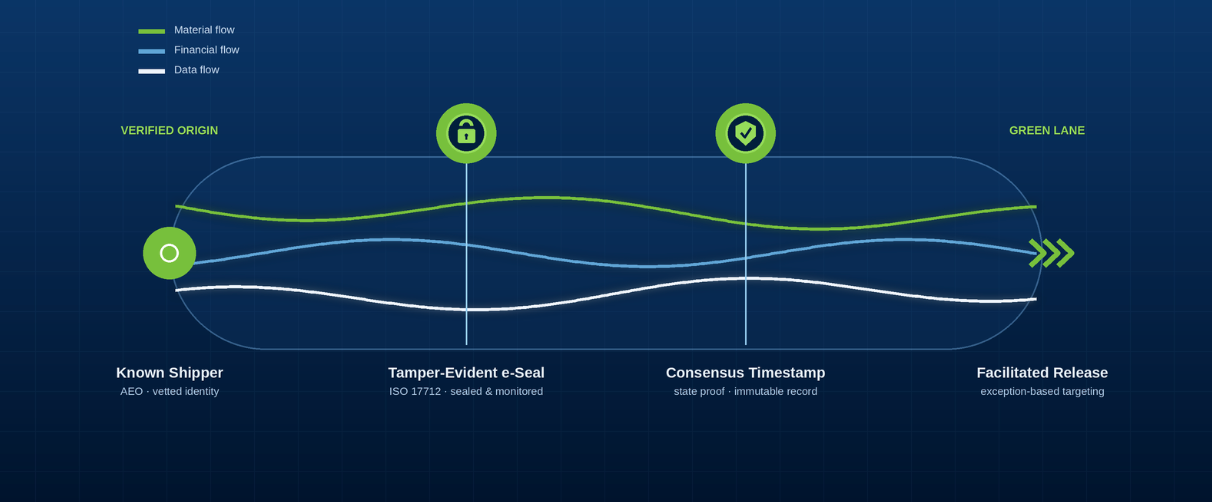
Three flows carry every supply chain
When they agree, integrity exists. When they disagree, the disagreement is the finding, and that is where the work starts. Security is not something added on top: it is what a well-run chain produces.
03 / How we find the problem
By exception. Not by inspection.
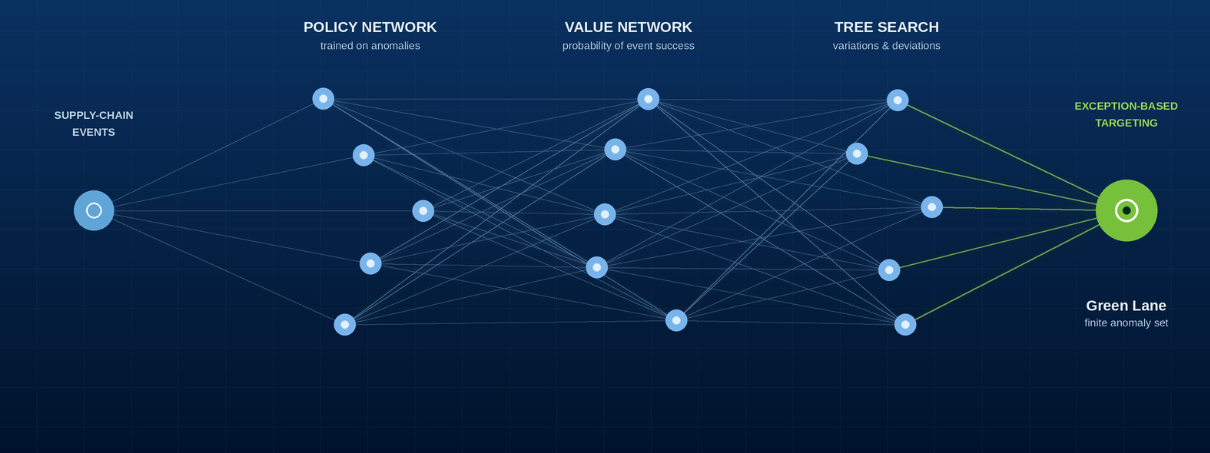
Traditional engagements inspect everything and report months later, so cost grows with scope. SIMS works out what should have happened, reconciles it against what did, and opens only what disagrees.
The usual way
Inspect everything
Scope the whole estate, report in months, bill by scope.
The SIMS way
Open only the exceptions
Reconcile first, investigate only what disagrees, bill by findings.
The order never changes: people, process, then technology. Technology amplifies expert judgment. It never replaces it.
The SIMS evidentiary standard
Pass the validation you cannot schedule.
Consultants read the criteria. SIMS designed and delivered the training that taught the agency's specialists to test them. The difference shows up in one place: whether the file holds when the inspection lands unannounced.
In active developmentPlatform behavior shown is intended architecture. Method and figures marked verified are delivered engagements.
04 / The tools we use
Operations research and risk analytics
Two toolkits, applied to real networks: one to engineer how the chain performs, one to measure where it is exposed.
Supply chain engineering
Resolving time, quality and cost at once.
Risk analytics
Every exposure broken into threat, vulnerability and consequence.
Where this lands
The method exists to fix five problems.
Everything SIMS, without the wait
Read, learn, buy, ask, or request portal access. Every route starts without a sales call, and every purchase opens your own hub.
One hub, five ways in
Pick the door that matches how you buy
Read · free
Guides & articles
Plain-English guides, white-paper previews, and the 90-second exposure assessment. No signup. New: Dan Garcia on the published CTPAT broker list.
Browse free →Learn
On-demand classes
Self-paced masterclasses mapped to each service. Buy once, watch anytime.
See classes →Buy
Fixed-price services
Productized engagements with a clear price and a defined scope. Start without a call.
See the ladder →Your hub
Client portal
Upload and track your CTPAT certification and validation. Your compliance, in one place.
Go to the portal →Featured · Trade Insight Commentary · September 2026
A List That Was Never Supposed to Exist?
CBP has made the identities of CTPAT-validated customs brokers public. Does the partner agreement permit it? Is this what the SAFE Port Act contemplated? And should importers, carriers and every other partner category expect to be next?
By Dan Garcia, Director and Senior Analyst. Four pages, PDF.
01Articles & papers
From the practice
Commentary · CTPAT
A List That Was Never Supposed to Exist?
CBP published the CTPAT-validated broker list. Dan Garcia asks whether the partner agreement, the SAFE Port Act or FOIA ever forbade it, and what Executive Order 14411 changes.
Read the commentary (PDF) →Article
Budgeting 2.78% supply chain inflation? Audit the pass-through first.
Why an index-linked budget line hides a pass-through problem, and what to test in your own records before you accept the number.
Read the article →Article
The Care Continuum Starts at the Source
Why patient care begins long before the bedside, at the source.
Read the article (PDF) →Article · SIMS Integrity Index
Measuring diversion
How the Integrity Index reconciles price, movement and sale to put a number on gray-market diversion.
Read the article (PDF) →White paper
Security as the Byproduct of a Well-Run Supply Chain
The heritage paper: the mathematics of readiness, and why the end of de minimis is an asset-management problem.
Read the method →Briefing
$29.99 /mo
or $299/year · individuals & small teams
Includes your client hub
Most popular
Intelligence Pro
$149.99 /mo
or $1,499/year · compliance & leadership teams
Includes your client hub
Free Briefing email available. Enterprise and association licensing on request. Cancel anytime.
Not ready to subscribe?
Start with a free issue
Get one full briefing and the monthly headline digest free. See the quality, then upgrade when the next mandate makes it urgent.
No card required. Unsubscribe anytime.
Free issue
Send me a free briefing
We will email a full sample issue and add you to the monthly digest.
Maps to: CTPAT validation
The CTPAT Compliance Masterclass
$499
on-demand · lifetime access
The framework, taught by the team that trained CBP’s own validators, from corporate security through every Minimum Security Criteria category, with the templates auditors expect.
Includes your client hub
Join the waitlist →Maps to: IOR Exposure Review
Foreign Importer Readiness
coming soon · on-demand
Self-assess your importer-of-record exposure and build your path to a CTPAT-validated broker filing. The do-it-yourself version of the Exposure Review.
Notify me / ask AI →Maps to: Market access
US Market Entry for Devices
coming soon · on-demand
GPO and IDN access and the health-economic case, taught for device and pharma teams entering the US market.
Notify me / ask AI →Every class includes your hub
Learn it yourself, then hand us only what you want done
A class teaches the standard. An engagement executes it. Most clients do both, in that order.
Next step
Watch the class, then bring us in for the parts you would rather not run.
See the service ladderOne secure home for every document
Upload once. We read it, track it, and remind you before anything lapses.
No more hunting through inboxes for your power of attorney or your last validation report.
Encrypted at rest and in transit. You control who on your team and ours can see each document.
Illustrative view of a client hub
CTPAT Certification
Uploaded · valid through 2027
Validation Report, Tier 2
Uploaded · next review in 18 months
Power of Attorney
Drag and drop to upload
Security Profile
Drag and drop to upload
What the hub does
Every SIMS purchase comes with your hub
A class, a subscription, an Exposure Review, or a full engagement. Even the free assessment can open a lightweight account. One login for all of it.
Track your CTPAT certification and validation, with renewal reminders
Watch the classes you have bought, anytime
Read members-only briefings and full white papers
Start an Exposure Review at your member rate
Ask SIMS AI with your account context attached
Message your SIMS team in one thread, no email chains
Next step
Open a hub with your first purchase
The free assessment opens a lightweight account. Everything after that lands in the same place.
02Learn
Buy once, lifetime access
The CTPAT Compliance Masterclass
The framework taught by the team that trained CBP’s own validators, with the templates auditors expect.
$499
View class →Foreign Importer Readiness
Self-assess your importer-of-record exposure and build your path to a validated broker filing.
Coming soon
Notify me →US Market Entry for Devices
GPO and IDN access and the health-economic case, for device and pharma teams.
Coming soon
Notify me →03Engagements
Scoped per client *
IOR Exposure Review
Your front door. A read on your exact exposure, your gaps named, and a path forward, credited back if you proceed.
Flat fee
Start →CTPAT / Trusted Trader Certification
Eligibility through validation and annual maintenance, built against the standard we taught the reviewers.
Firm fixed fee
$50k to $120k
Done-for-You Compliance Restructure
US nexus, bonding strategy, beneficial-ownership documentation, good-standing posture.
Firm fixed fee
$75k to $150k
Bond & Surety Strategy
Sizing, placing and defending customs bonds; CBP sufficiency actions; collateral structuring and release.
Scoped
Ask about this →Duty recovery & drawback
Overpaid duty, unfiled drawback and valuation exposure pursued through the lawful channels.
Success fee
See the drawback scope →SIMS Medical Market Entry
Foreign-IOR compliance and CTPAT readiness paired with GPO and IDN access and the health-economic case.
$150k to $500k+
See the market-entry path →* Ranges are indicative and scoped per engagement. Recovery engagements may use a separate commercial model, documented before work begins. Outcomes that require an agency decision, including certification, validation, refund and clearance, are never guaranteed. The Integrity Index and GLaaS™ are